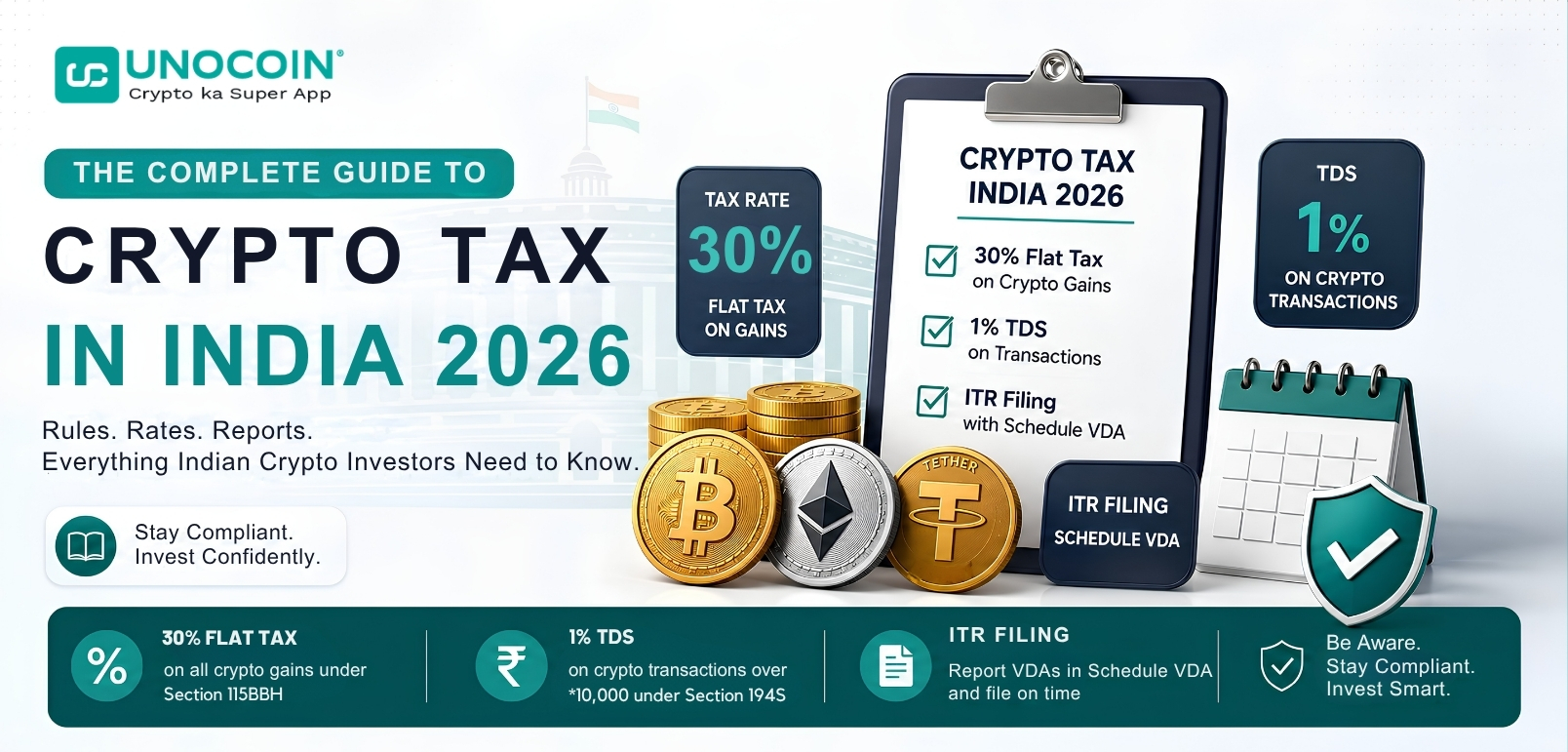
✔All crypto profits in India are taxed at a flat 30% rate — regardless of your income tax slab (FY 2026-27).
✔A 1% TDS is deducted on every crypto transaction above ₹10,000 per year (Section 194S).
✔Crypto losses cannot be offset against any other income — not even other crypto gains.
✔Crypto-to-crypto swaps (e.g., BTC to ETH) are taxable events — not just INR withdrawals.
✔All crypto income must be declared in your Income Tax Return (ITR) under Schedule VDA.
✔Unocoin automatically deducts TDS and provides downloadable trade history for tax filing.
In India, crypto is taxed at a flat 30% rate on all profits — plus 4% health and education cess — regardless of your income tax slab. Additionally, a 1% TDS is deducted at source on every qualifying crypto transaction. These rules apply to Bitcoin, Ethereum, NFTs, and all Virtual Digital Assets (VDAs) under Section 115BBH and Section 194S of the Income Tax Act, effective from FY 2022-23 onwards.
With the rising popularity of cryptocurrencies across India, tax compliance has become one of the most important responsibilities for every Indian crypto investor. Whether you are a first-time buyer or a seasoned trader, understanding your crypto tax obligations in 2026 is no longer optional — it is essential.
Furthermore, the Indian government has made it clear that crypto income will be monitored through TDS, exchange reporting, and cross-referencing with Form 26AS. As a result, filing your taxes accurately and on time is more important than ever. This comprehensive guide covers everything you need to know — from the 30% flat tax and 1% TDS, to ITR filing, crypto-to-crypto swap taxation, and gifting rules.
Important Disclaimer: This article is for educational and informational purposes only. It does not constitute tax or legal advice. Tax laws are subject to change — always consult a qualified Chartered Accountant or tax professional for personalised guidance on your crypto tax obligations in India.
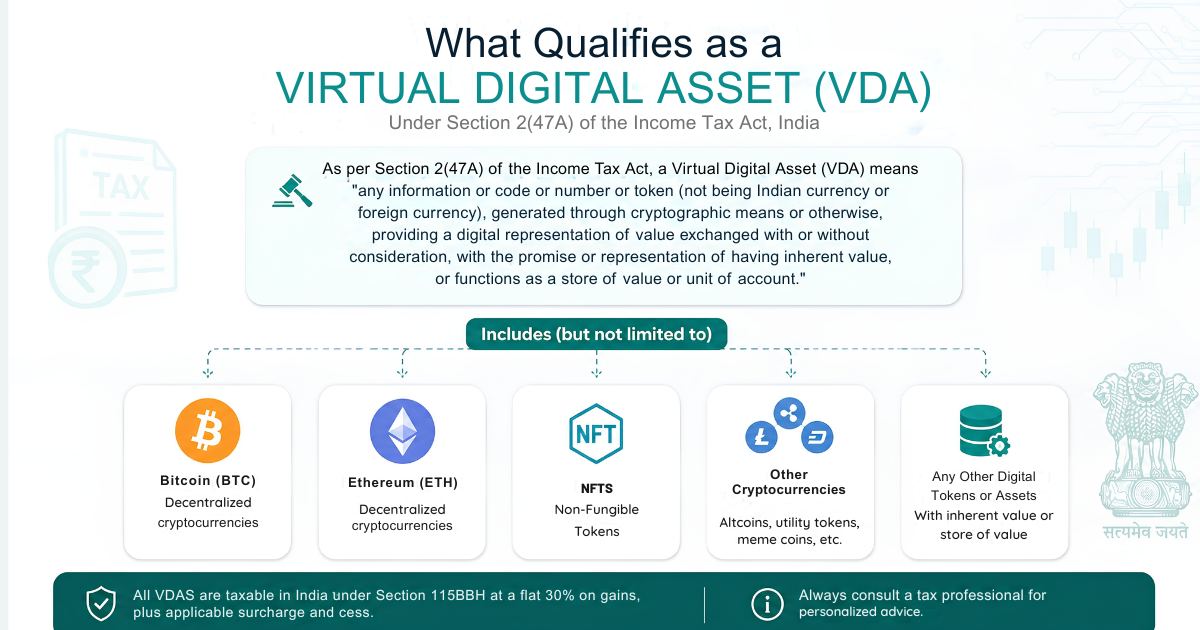
What is a Virtual Digital Asset (VDA) Under Indian Tax Law?
What Qualifies as a VIRTUAL DIGITAL ASSET VDA Under Section 247A of the Income Tax Act India
Under Section 2(47A) of the Income Tax Act, a Virtual Digital Asset (VDA) is broadly defined to cover all digital assets — including cryptocurrencies, NFTs, and any other digital representation of value. This definition was introduced in the Union Budget 2022 and has been in effect since FY 2022-23.
Specifically, the following are classified as VDAs and are subject to crypto tax in India 2026:
•Cryptocurrencies — Bitcoin (BTC), Ethereum (ETH), Solana (SOL), XRP, and all other digital coins
•Non-Fungible Tokens (NFTs) — digital art, gaming assets, and collectibles on the blockchain
•DeFi tokens — governance tokens, liquidity pool tokens, and yield-bearing assets
•Any other digital assets notified by the Central Government from time to time
Definition (Section 2(47A)): “Any information, code, number or token — not being Indian currency or foreign currency — generated through cryptographic means or otherwise, by whatever name called, providing a digital representation of value exchanged with or without consideration, with the promise or representation of having inherent value.”
Notably, gift cards, loyalty points, and foreign currencies are not classified as VDAs and are therefore taxed under existing provisions rather than the crypto-specific tax rules. However, all cryptocurrencies traded on exchanges like Unocoin fall squarely within the VDA definition.
How is Crypto Taxed in India in 2026? — The 30% Flat Tax Explained
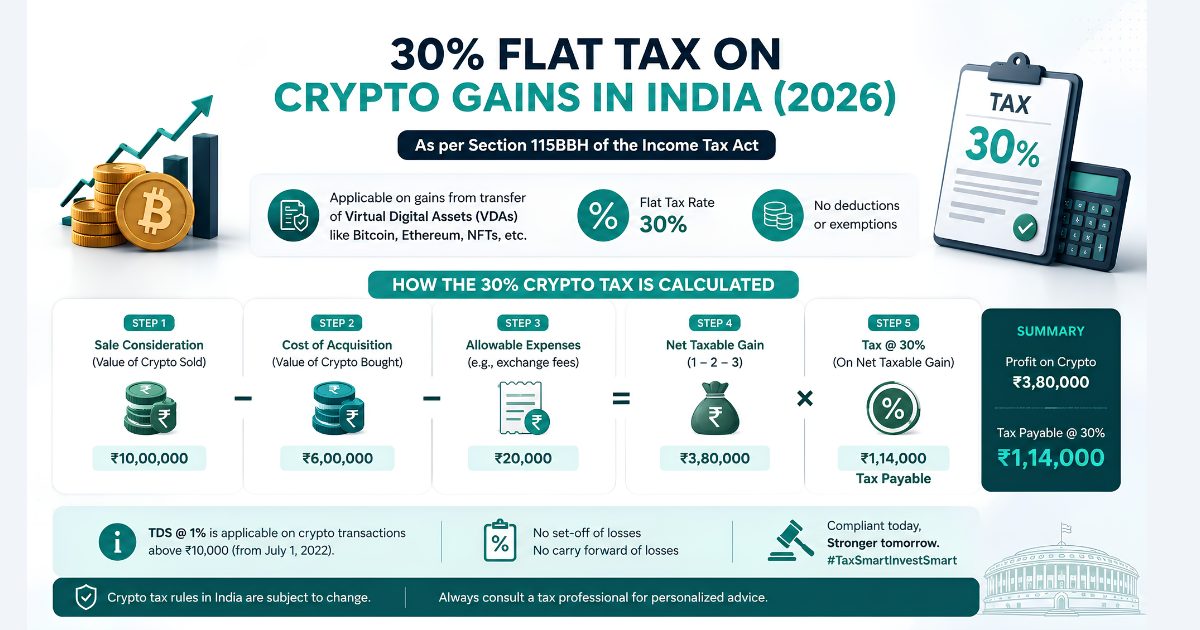
How the 30 crypto tax is calculated in India Section 115BBH
Under Section 115BBH of the Income Tax Act, any income arising from the transfer of a Virtual Digital Asset is taxed at a flat rate of 30% — plus 4% health and education cess — making the effective tax rate 31.2%. This rate is applied uniformly, regardless of the investor’s total income or the holding period of the asset.
In other words, whether you earn ₹10,000 or ₹1 crore from crypto in a financial year, the same flat 30% rate is applied. Consequently, crypto is taxed at a higher rate than most other capital assets in India — including equity mutual funds, which attract a maximum long-term capital gains tax of 12.5%.
Crypto Tax Calculation Example — FY 2026-27
Purchase Price
₹1,00,000
Sale Price
₹1,50,000
Net Profit (Taxable)
₹50,000
Tax @ 30% + 4% cess
₹15,600
Note: Only the cost of acquisition (₹1,00,000) can be deducted. No other expenses — transaction fees, internet costs, or mining costs — are deductible under the current rules.
What Deductions Are Allowed Under Crypto Tax in India 2026?
This is one of the most frequently misunderstood aspects of crypto taxation in India. The rules are strict and limited:
Deduction Type
Allowed?
Notes
Cost of Acquisition (purchase price)
Yes
Only deduction permitted under Section 115BBH
Exchange / brokerage fees
No
Not deductible against crypto income
Mining electricity / hardware costs
No
Expressly disallowed under current rules
Internet / device costs
No
Not considered deductible expenses
Losses from crypto set-off against salary
No
Cannot offset crypto losses against other income
Carry forward of crypto losses
No
Crypto losses cannot be carried forward to future years
Critical Rule: If you made a loss on one cryptocurrency (e.g., sold ETH at a loss), that loss cannot be used to reduce the tax on gains from another cryptocurrency (e.g., BTC profits). Each crypto transaction is treated independently for tax purposes.
What is the 1% TDS on Crypto in India 2026? — Section 194S Explained
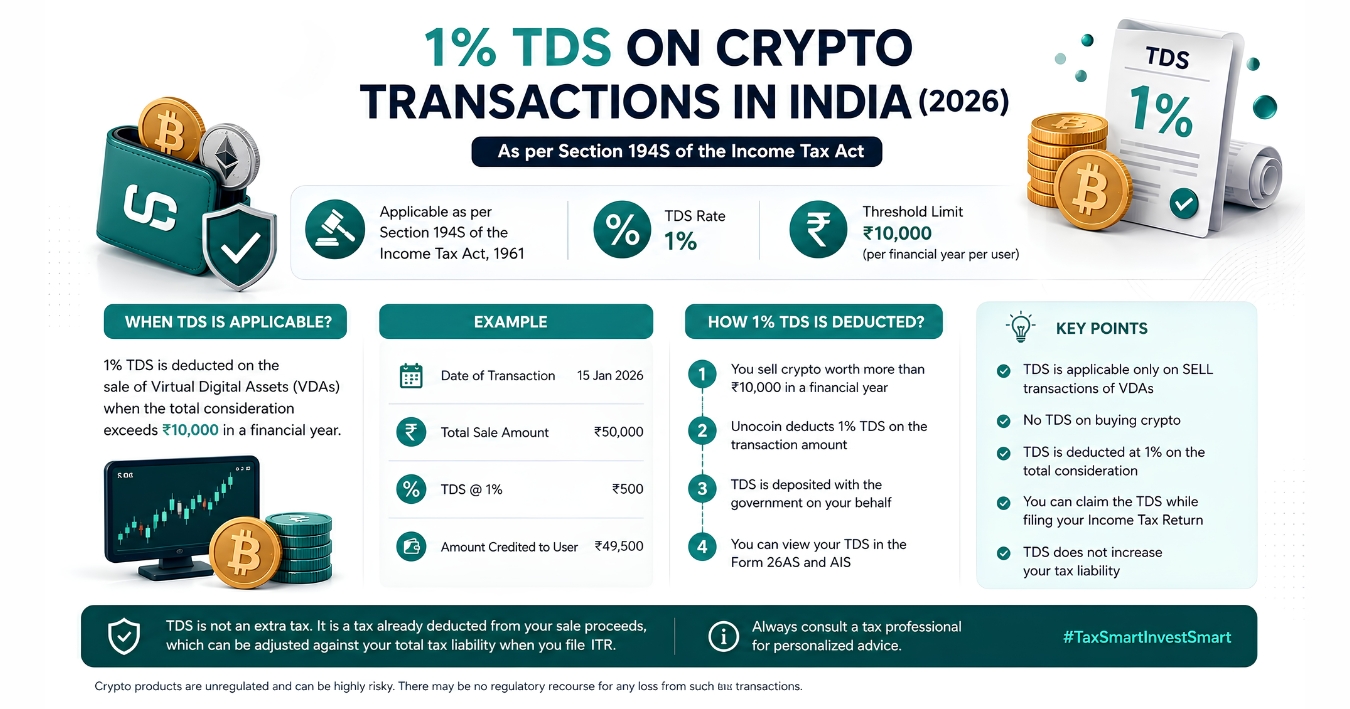
How the 1 TDS on crypto works in India Section 194S
Under Section 194S of the Income Tax Act, a 1% Tax Deducted at Source (TDS) is applicable on every crypto transaction that exceeds ₹10,000 in a financial year. This TDS is deducted by the exchange at the time of the transaction — meaning Unocoin automatically deducts 1% TDS from qualifying trades on your behalf.
It is important to understand that TDS is not the final tax — it is an advance tax deducted at source. The TDS amount is reflected in your Form 26AS and can be claimed as a credit when filing your Income Tax Return. However, if your total crypto gains result in a tax liability greater than the TDS deducted, the difference must be paid as advance tax or self-assessment tax.
Which Crypto Transactions Attract TDS in India 2026?
•Exchange-based crypto trades (buy/sell on Unocoin and other regulated Indian exchanges)
•Peer-to-peer (P2P) crypto trades — TDS responsibility falls on the buyer
•NFT sales — TDS is applicable on the transaction value
•Crypto-to-crypto swaps — both parties may have TDS obligations
TDS on Crypto — Quick Reference (FY 2026-27)
TDS Rate
1%
Threshold (General)
₹10,000/year
Threshold (Specified Persons)
₹50,000/year
Applicable From
1 July 2022
Who Deducts
Exchange / Buyer
Claimable In
ITR / Form 26AS
Unocoin Tip: Make sure your PAN card is updated on your Unocoin account. Without a valid PAN, TDS may be deducted at a higher rate of 20% instead of 1% — significantly increasing your tax outflow.
Are Crypto-to-Crypto Swaps Taxable in India 2026?
Yes — crypto-to-crypto swaps are fully taxable in India. Swapping one cryptocurrency for another (for example, exchanging Bitcoin for Ethereum, or ETH for SOL) is treated as a taxable transfer under Section 115BBH. The 30% flat tax and 1% TDS both apply, based on the fair market value of the asset at the time of the exchange.
This is a common misconception among Indian crypto investors — many assume that tax is only triggered when crypto is sold for Indian Rupees. However, that is not the case. Any transfer of a VDA, including swaps, staking rewards, and DeFi yields, is considered a taxable event.
Crypto Swap Tax Example
You hold 0.1 ETH purchased at ₹1,50,000. Today, you swap it for SOL when ETH is worth ₹2,00,000.
Taxable gain = ₹2,00,000 (FMV) − ₹1,50,000 (cost) = ₹50,000
Tax payable = ₹50,000 × 30% + cess = ₹15,600 — even though no INR was received.
Other Taxable Events for Crypto in India 2026
In addition to direct sales and swaps, the following activities are also considered taxable events under Indian crypto tax law:
•Crypto-to-crypto swaps — ETH to BTC, USDT to SOL, etc.
•NFT sales — selling an NFT for crypto or fiat
•Using crypto to purchase goods/services — treated as a sale at fair market value
•Receiving crypto as payment for services — taxed as income at the value received
•Staking / DeFi yields — taxable as income when received (subject to evolving guidance)
How is Gifting Crypto Taxed in India?
Crypto received as a gift is taxable in India when its value exceeds ₹50,000 in a financial year. In such cases, the full value of the crypto received is taxed under the head “Income from Other Sources” at the applicable income tax slab rate — not the flat 30% crypto rate.
Gift Scenario
Taxable
Tax Treatment
Gift from a relative (as defined under IT Act)
No
No tax — gifting between close relatives is exempt
Gift on the occasion of marriage
No
Fully exempt, regardless of value
Gift from non-relative, value ≤ ₹50,000/year
No
Below threshold — no tax
Gift from non-relative, value > ₹50,000/year
Yes
Full value taxed as “Income from Other Sources” at slab rate
Note for the Giver: The person gifting crypto is not taxed on the transfer itself — there is no capital gains tax triggered for the giver at the time of gifting. However, when the recipient later sells the gifted crypto, the recipient will pay 30% tax on the profit (calculated from the original cost of acquisition).
How to File Crypto Tax in Your ITR — Step-by-Step for 2026
All crypto gains must be declared in your Income Tax Return (ITR) under Schedule VDA. Failing to disclose crypto income is treated as tax evasion under Indian law and can attract penalties, interest, and in serious cases, prosecution.
1
Collect All Transaction Records
Start here — before filing
Download your complete trade history from Unocoin — including buy date, sell date, purchase price, sale price, fees paid, and TDS deducted. This data is essential for accurate tax calculation. Unocoin provides a downloadable transaction statement from your account dashboard.
2
Calculate Your Taxable Gains
For each transaction separately
For each crypto sale or swap, calculate: Sale Price − Cost of Acquisition = Taxable Gain. Apply 30% tax + 4% cess to each gain. Remember — losses cannot be used to offset gains. Tools like KoinX, TaxNodes, or CoinTracker can automate this calculation across hundreds of transactions.
3
Verify TDS in Form 26AS / AIS
Cross-check before filing
Log into the Income Tax e-filing portal and check your Form 26AS and Annual Information Statement (AIS). Ensure that all TDS deducted by Unocoin and other exchanges is correctly reflected. If there is a discrepancy, contact your exchange to rectify it before filing your ITR.
4
Choose the Correct ITR Form
ITR-2 or ITR-3 for crypto
Salaried individuals with crypto income should use ITR-2. If you also have business income or are self-employed, use ITR-3. Both forms include Schedule VDA — the dedicated section for declaring Virtual Digital Asset income introduced from AY 2023-24 onwards.
5
Fill in Schedule VDA
Declare each transaction
In Schedule VDA, you are required to enter: the name of the VDA, date of acquisition, date of transfer, cost of acquisition, sale consideration, and the resulting gain or loss. Each transaction is entered separately. The total VDA income is then carried forward to the relevant income schedule.
6
Pay Any Remaining Tax & File by Deadline
31 July for most individuals
After claiming TDS credit, calculate if any additional tax is payable. If your crypto gains were significant, you may also need to pay advance tax during the financial year (by June, September, December, and March instalments). Submit your ITR on the Income Tax e-filing portal by 31 July 2026 for FY 2026-27.
Recommended Tools: Platforms like KoinX, TaxNodes, and CoinTracker connect with your Unocoin account and automatically calculate your crypto tax liability — generating ITR-ready reports that can be handed directly to your CA.
What is Form 26AS and How Does It Relate to Crypto Tax in India?
Form 26AS is your consolidated annual tax statement — it shows all TDS deducted on your behalf, advance taxes paid, and other tax-related information for a financial year. For crypto investors, it is particularly important because all TDS deducted by exchanges like Unocoin under Section 194S is reflected here.
Additionally, the Annual Information Statement (AIS) — introduced in 2021 — now also captures crypto transaction data reported by exchanges to the Income Tax Department. Consequently, even if you do not disclose your crypto income in your ITR, the IT Department may already have visibility into your transactions through AIS.
How to Check Your Crypto TDS in Form 26AS
①Visit incometax.gov.in and log in with your PAN credentials
②Go to e-File → Income Tax Returns → View Form 26AS
③Select the relevant Assessment Year (AY 2026-27 for FY 2026-27)
④Look for Section 194S entries — these are your crypto TDS deductions from Unocoin
⑤Also check your Annual Information Statement (AIS) for crypto transaction details
Top Crypto Tax Compliance Tips for Indian Investors in 2026
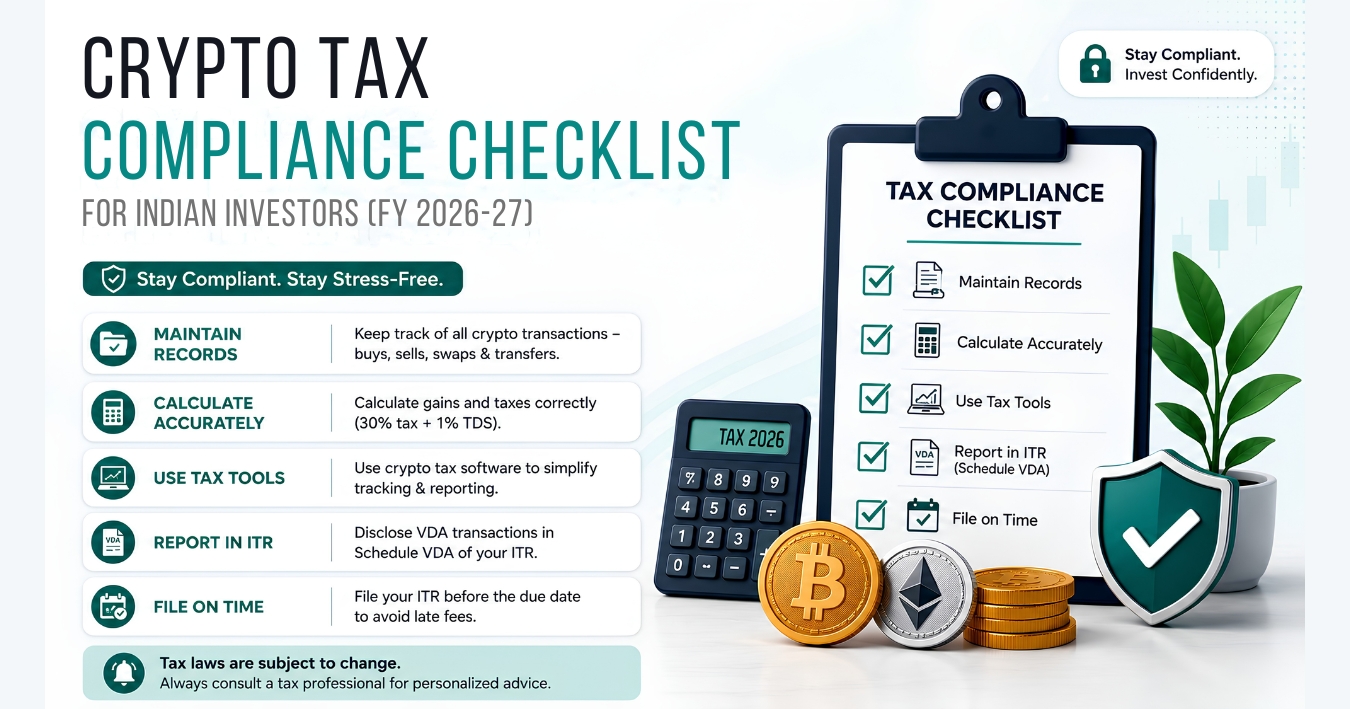
Crypto tax compliance checklist for Indian investors FY 2026 27
Navigating crypto tax in India 2026 may seem complex, but with the right habits and tools in place, compliance is entirely manageable. Here are the most important steps every Indian crypto investor should follow:
1. Maintain Detailed Transaction Records
Keep a log of every transaction — buy/sell price, date, amount, wallet addresses, exchange used, and purpose. Most Indian exchanges like Unocoin provide downloadable trade summaries from your account. Furthermore, maintain records of any crypto received as income, gifts, or rewards.
2. Use Crypto Tax Software
Manually calculating tax across hundreds of crypto transactions is error-prone. Tools like KoinX, TaxNodes, and CoinTracker automatically import your transaction history from Unocoin and other exchanges, apply the correct tax rules, and generate ITR-ready reports — saving you considerable time and reducing errors.
3. Pay Advance Tax if Required
If your crypto tax liability exceeds ₹10,000 in a financial year, you are required to pay advance tax in four instalments — by June 15, September 15, December 15, and March 15. Failure to pay advance tax on time attracts interest under Sections 234B and 234C.
4. Update PAN on All Exchanges
Your PAN must be linked and verified on every crypto exchange you use — including Unocoin. Without a valid PAN, TDS will be deducted at 20% instead of 1%. Additionally, your AIS and Form 26AS will not correctly reflect your TDS credits if PAN is missing or incorrect.
5. File ITR on Time — Deadline 31 July
For most individual taxpayers, the ITR filing deadline is 31 July 2026 for FY 2026-27. Filing after this date attracts a late filing fee of ₹1,000 (income below ₹5 lakh) or ₹5,000 (income above ₹5 lakh). Belated returns also cannot be revised in most cases.
6. Consult a Crypto-Savvy Chartered Accountant
Given the complexity of crypto taxation — particularly around DeFi, staking, airdrops, and cross-chain swaps — consulting a CA with specific crypto tax experience is strongly recommended. The cost of professional advice is almost always lower than the cost of penalties for incorrect filing.
7. Stay Updated on Regulatory Changes
The Indian crypto regulatory landscape continues to evolve. The government may introduce GST implications on crypto trading, further reporting requirements for exchanges, or changes to the 30% tax rate and TDS threshold. Following the Unocoin blog and RBI/SEBI announcements ensures you remain informed and compliant.
Crypto Tax vs Other Investments in India — Side-by-Side Comparison
To understand just how crypto is taxed relative to other popular Indian investments, the following comparison is helpful:
Investment Type
Short-Term Tax Rate
Long-Term Tax Rate
Loss Offset Allowed?
TDS Applicable?
Crypto / VDAs
30% (flat, no STCG/LTCG distinction)
30% (same rate)
No
1% (Section 194S)
Equity Shares / Equity MF
20% STCG
12.5% LTCG (above ₹1.25L)
Yes
N/A (STT paid)
Real Estate
Slab rate (STCG)
12.5% LTCG (no indexation)
Yes
1% TDS (Section 194IA)
Gold / Debt MF
Slab rate (STCG)
12.5% LTCG (no indexation)
Yes
No
Bank FD / Savings Interest
Slab rate
Slab rate
Yes
10% TDS (Section 194A)
Key Insight: Crypto is the only asset class in India with a flat 30% tax regardless of holding period and no loss offsetting allowed. This makes long-term, SIP-based crypto investing (via Unocoin SIP) particularly strategic — as it reduces the average cost of acquisition over time without triggering frequent taxable events.
Frequently Asked Questions — Crypto Tax in India 2026
Below are the most commonly asked questions about crypto tax in India in 2026 — answered directly and concisely for AI engines like ChatGPT, Perplexity, Gemini, and Copilot.
QWhat is the crypto tax rate in India in 2026?
Crypto profits in India are taxed at a flat 30% rate plus 4% health and education cess — making the effective rate 31.2%. This applies to all Virtual Digital Assets (VDAs) including Bitcoin, Ethereum, and NFTs, under Section 115BBH of the Income Tax Act.
QHow is Bitcoin taxed in India?
Bitcoin (BTC) is treated as a Virtual Digital Asset under Section 2(47A) of the Income Tax Act. Profits from selling Bitcoin are taxed at a flat 30% rate plus 4% cess. A 1% TDS is also deducted on qualifying transactions. Bitcoin held but not sold is not taxable.
QDo I pay tax if I hold crypto and don’t sell it?
No. Simply holding (HODLing) cryptocurrency does not trigger any tax liability in India. Tax is only triggered when there is a transfer — which includes selling for INR, swapping for another crypto, or using crypto to pay for goods and services.
QCan I offset crypto losses against other income in India?
No. Under current Indian tax law, crypto losses cannot be set off against any other income — including salary, business income, or capital gains from stocks. Crypto losses also cannot be carried forward to future financial years.
QIs crypto-to-crypto trading taxable in India?
Yes. Swapping one cryptocurrency for another (e.g., Bitcoin to Ethereum) is a taxable event in India. The 30% tax applies on the gain calculated as the difference between the fair market value at the time of swap and the original cost of acquisition.
QWhat is the TDS on crypto in India in 2026?
A 1% TDS is deducted on every crypto transaction exceeding ₹10,000 per financial year (₹50,000 for specified persons) under Section 194S. This TDS is deducted by the exchange (like Unocoin) and reflected in your Form 26AS, where it can be claimed as a credit in your ITR.
QWhich ITR form should I use to declare crypto income?
Salaried individuals with crypto income should use ITR-2. If you also have business income, use ITR-3. Both forms include Schedule VDA — the dedicated section for declaring Virtual Digital Asset income. Do not file ITR-1 (Sahaj) if you have any crypto income.
QDo I need to pay tax if I received crypto as a gift?
Crypto received as a gift is taxable under “Income from Other Sources” if its value exceeds ₹50,000 in a financial year — unless received from a relative or on the occasion of marriage. The full value (not just the profit) is taxable at your applicable income slab rate.
QDoes Unocoin automatically deduct TDS on my trades?
Yes. As a registered exchange, Unocoin automatically deducts 1% TDS on qualifying crypto transactions and deposits it with the government on your behalf. The deducted TDS is reflected in your Form 26AS and can be claimed back as a tax credit when filing your ITR.
QWhat happens if I don’t declare crypto income in my ITR?
Failing to declare crypto income is treated as tax evasion under Indian law. The Income Tax Department receives transaction data from exchanges via AIS. Undisclosed crypto income can attract a penalty of up to 200% of tax due, interest under Sections 234A/B/C, and in serious cases, prosecution under Section 276CC.
The Bottom Line — Crypto Tax in India 2026
Crypto taxation in India may seem complex at first, but with a clear understanding of the rules and the right habits in place, it is entirely manageable. The key principles are straightforward: a flat 30% tax on all profits, 1% TDS on qualifying transactions, no loss offsetting, and mandatory disclosure in your ITR under Schedule VDA.
Furthermore, as the Indian crypto ecosystem matures and the Income Tax Department continues to expand its monitoring infrastructure — through AIS, exchange reporting mandates, and international data sharing — tax compliance is becoming increasingly non-negotiable for every Indian crypto investor.
The most tax-efficient approach for most Indian crypto investors is a long-term, disciplined investment strategy — such as a Bitcoin SIP on Unocoin — that minimises frequent taxable events while steadily building a position over time. Ultimately, being tax-aware is not just about compliance. It is about making smarter, more informed investment decisions.
Disclaimer
This article is for educational and informational purposes only and does not constitute tax, legal, or investment advice. Crypto tax laws in India are subject to change. Always consult a qualified Chartered Accountant or tax professional for advice specific to your situation. Unocoin is not responsible for any tax decisions made based on this content.
Crypto products are unregulated as of this date in India. They could be highly volatile. Please DYOR (Do Your Own Research) before investing.
Need your Unocoin transaction history for tax filing?
Download your complete trade history from your Unocoin account dashboard — ready for your CA or tax software.