
Table of Contents
- Why Does Bitcoin Have Value?
- 9 Reasons Bitcoin Has Value
- Why Is Bitcoin Limited to 21 Million?
- Does Bitcoin Have Intrinsic Value?
- Who Decides the Price of Bitcoin?
- Why Does Bitcoin Have Value If It Isn’t Backed by a Government?
- Bitcoin vs Traditional Money
- Bitcoin vs Gold
- Why Does Bitcoin’s Value Change So Much?
- Can Bitcoin Lose Its Value?
- A Simple Example of How Bitcoin Gets Its Value
- Frequently Asked Questions
Bitcoin has no physical form, is not issued by a central bank, and does not represent ownership in a company. So why is Bitcoin valuable?
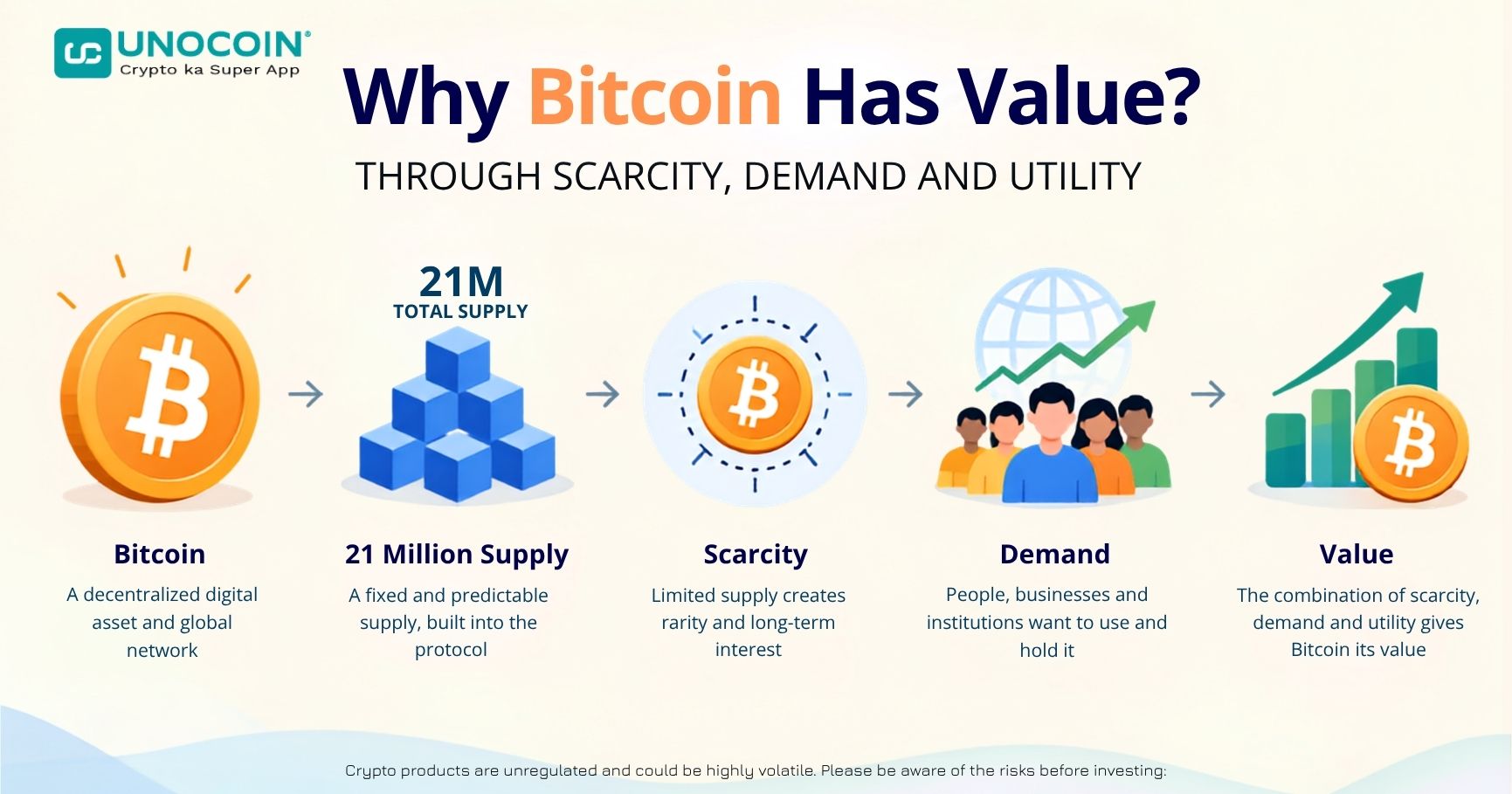
Bitcoin has value because people are willing to use, hold, buy and sell it based on a combination of factors including scarcity, utility, security, decentralisation, liquidity, adoption and network effects. Its market price is ultimately determined by supply and demand.
Why Does Bitcoin Have Value?
Bitcoin has value because it combines several characteristics that people find useful in a form of digital money or digital asset. These include:
| 1Scarcity |
| 2Demand |
| 3Utility |
| 4Decentralisation |
| 5Security |
| 6Network Effects |
| 7Divisibility |
| 8Portability |
| 9Liquidity and Market Adoption |
9 Reasons Bitcoin Has Value
Key Takeaways
✔Bitcoin has a maximum supply of 21 million coins
✔Scarcity is one factor — but scarcity alone does not create value
✔Bitcoin can be transferred without a traditional payment intermediary
✔Its decentralised network verifies transactions without a single central authority
✔Bitcoin is divisible, portable and transferable globally
✔Demand comes from people and organisations who value these properties
✔Bitcoin’s market price is determined by buyers and sellers in the market
✔ Bitcoin can also lose value — limited supply does not guarantee price growth
Why Is Bitcoin Limited to 21 Million?
The 21 million supply limit is part of Bitcoin’s monetary design. New bitcoins are created through block rewards paid to miners. The reward decreases through periodic halvings, reducing the rate at which new Bitcoin enters circulation. The combination of a predetermined issuance schedule and a maximum supply is one of Bitcoin’s defining characteristics.
Does Bitcoin Have Intrinsic Value?
The question of whether Bitcoin has “intrinsic value” is debated. Bitcoin does not have intrinsic value in the same way that some physical commodities have uses outside their monetary role. For example, gold has industrial and jewellery applications in addition to being held as an asset.
Bitcoin’s value is primarily connected to the properties and functionality of its network, along with the willingness of market participants to use and value it.
|
Supporters say
→Scarcity is built into the protocol →Security and decentralisation are valuable →Portability and divisibility are practical →Censorship resistance has real utility |
Critics say
→No physical commodity use case →Value depends heavily on continued adoption →No cash flows or dividends →Speculative demand may drive price |
Who Decides the Price of Bitcoin?
There is no single organisation that sets the global Bitcoin price. Bitcoin’s market price emerges from buying and selling activity across markets. When buyers are willing to pay more and demand increases, the market price can rise. When sellers dominate or demand decreases, the price can fall.
Factors that can influence Bitcoin’s market price include:
|
→Supply and demand →Investor sentiment →Market liquidity →Macroeconomic conditions |
→Regulation and government policy →Institutional participation →Adoption and market expectations →Bitcoin-related news and events |
The underlying Bitcoin protocol does not set a fixed rupee or dollar price for one BTC.
The market does.
Why Does Bitcoin Have Value If It Isn’t Backed by a Government?
Traditional currencies such as the Indian rupee are issued and managed within a government and central-bank monetary system. Bitcoin operates differently — it is not backed by a government promising to exchange it for a fixed amount of another asset. Instead, Bitcoin’s monetary properties come from its protocol and the network that follows those rules.
People who value Bitcoin may choose to hold or use it because of characteristics such as:
|
→Predictable issuance schedule →Limited supply (~21 million BTC) |
→Decentralisation and global transferability →Resistance to changes by a single authority |
Bitcoin vs Traditional Money: Where Does Value Come From?
Bitcoin and traditional currencies have different monetary structures. Understanding these differences helps explain why some people assign value to Bitcoin.
| Feature | Bitcoin | Traditional Fiat (e.g. INR) |
|---|---|---|
| Issuance | Governed by protocol rules | Managed through monetary institutions |
| Maximum supply | ~21 million BTC (hard cap) | No fixed universal maximum |
| Physical form | Digital only | Physical and digital |
| Central authority | No single central issuer | Central bank and government system |
| Transfer network | Decentralised peer-to-peer network | Banks and payment networks |
| Supply schedule | Predictable — built into the protocol | Can change based on monetary policy |
| Price | Determined by market demand | Currency markets and economic conditions |
This does not mean one system is automatically better than the other. They are designed differently and serve different purposes.
Bitcoin vs Gold: Why Are They Compared?
Bitcoin is sometimes compared with gold because both have characteristics that can appeal to people looking for an asset with limited supply. The comparison is not perfect — gold has thousands of years of history as a monetary and cultural asset, while Bitcoin is a relatively new digital asset.
|
Bitcoin is:
→Digitally scarce →Divisible (to 1 satoshi) →Digitally portable (global transfer) →Secured through decentralised network →Governed by predictable protocol rules |
Gold is:
→Physically scarce (mined from earth) →Durable and recognisable →Physically divisible but costly →Thousands of years of monetary history →Industrial and jewellery uses |
| Feature | Bitcoin | Gold |
|---|---|---|
| Form | Digital | Physical |
| Supply | Protocol-defined (~21M BTC) | Naturally scarce |
| Divisibility | Very high — 100M satoshis | Divisible but costly |
| Portability | Digital transfer — instant | Physical transport required |
| History | Since 2009 (~15 years) | Thousands of years |
| Verification | Cryptographic / network | Physical / technical assay |
Whether Bitcoin ultimately behaves more like a digital form of money, a store of value, a speculative asset or something else remains a subject of ongoing debate.
Why Does Bitcoin’s Value Change So Much?
Bitcoin can be highly volatile because its market price depends on constantly changing supply and demand. Several factors can influence that demand simultaneously.
|
Positive market sentiment
→
More buying demand
→
Price may rise ↑
|
Negative market sentiment
→
More selling pressure
→
Price may fall ↓
|
Other factors: interest rates, regulation, institutional activity, liquidity, major market events
Can Bitcoin Lose Its Value?
Yes — Bitcoin’s market price is not guaranteed.
Bitcoin’s supply is limited, but that does not guarantee a particular price. If demand for Bitcoin were to fall significantly, its market value could decline.
Bitcoin also faces several real risks that investors should understand:
|
High price volatility Regulatory changes Loss of private keys |
Market manipulation Changing investor sentiment Competition from other technologies |
Scarcity should not be treated as a guarantee of future returns.
Limited supply does not eliminate market risk. Only invest what you can afford to lose.
A Simple Example of How Bitcoin Gets Its Value
Think of it like this
Imagine there are 1,000 units of a digital asset. The asset is difficult to create, useful to its users and trusted by a growing network. If many people want to own it while only a limited number of units are available, buyers may compete to acquire it. The price can rise.
Now imagine that demand falls sharply. Even though the supply remains limited, fewer people may be willing to buy it. The price can fall.
Limited supply + demand + utility + market confidence
= conditions that can support market value
But none of these factors guarantees a particular price.
Bitcoin Value in One Sentence
Bitcoin has value because people are willing to assign value to a scarce, transferable and divisible digital asset secured by a decentralised network — while its market price is determined by supply and demand.
What Actually Gives Bitcoin Its Value?
Summary — Bitcoin’s Value Drivers
1.Scarcity: Predetermined maximum supply of approximately 21 million BTC
2.Demand: People must want to own, use or trade Bitcoin for it to have market value
3.Utility: Provides a way to transfer and hold digital value through a peer-to-peer network
4.Decentralisation: The network does not rely on one central institution to maintain the ledger
5.Security: Cryptography, Proof of Work and distributed verification help protect the network
6.Network Effects: More users, infrastructure and market participation increases Bitcoin’s usefulness
7.Divisibility: Bitcoin can be divided into 100 million satoshis
8.Portability: Bitcoin can be transferred digitally without physically moving the asset
Remember: None of these characteristics individually guarantees Bitcoin’s price. Bitcoin’s market value remains determined by supply and demand, and its price can change significantly.
Frequently Asked Questions
Final Thoughts
Bitcoin’s value cannot be explained by scarcity alone. Its market value is the result of several characteristics working together: a predictable and limited supply, utility as a digital asset, decentralisation, security, divisibility, portability, liquidity and a growing network of participants.
At the same time, Bitcoin remains a volatile asset. A fixed supply does not guarantee that demand will remain strong or that its price will continue to rise. Understanding what gives Bitcoin value is therefore more useful than simply looking at its current price.
| For a broader introduction to Bitcoin, read our guide on What Is Bitcoin? → To understand what happens technically when Bitcoin is sent, verified and recorded, see How Does Bitcoin Work? → |
Ready to buy Bitcoin in India?
Start from as little as ₹100 on Unocoin — India’s oldest Bitcoin exchange since 2013. FIU-IND registered. Full KYC and INR support.
Disclaimer
This article is for informational and educational purposes only and does not constitute financial or investment advice. Cryptocurrency investments involve significant risk, including the possible loss of your entire investment. Bitcoin’s price is highly volatile and past performance is not indicative of future results. Always conduct your own research and consult a qualified financial advisor before making investment decisions. Crypto products are unregulated as of this date in India. Please DYOR (Do Your Own Research).