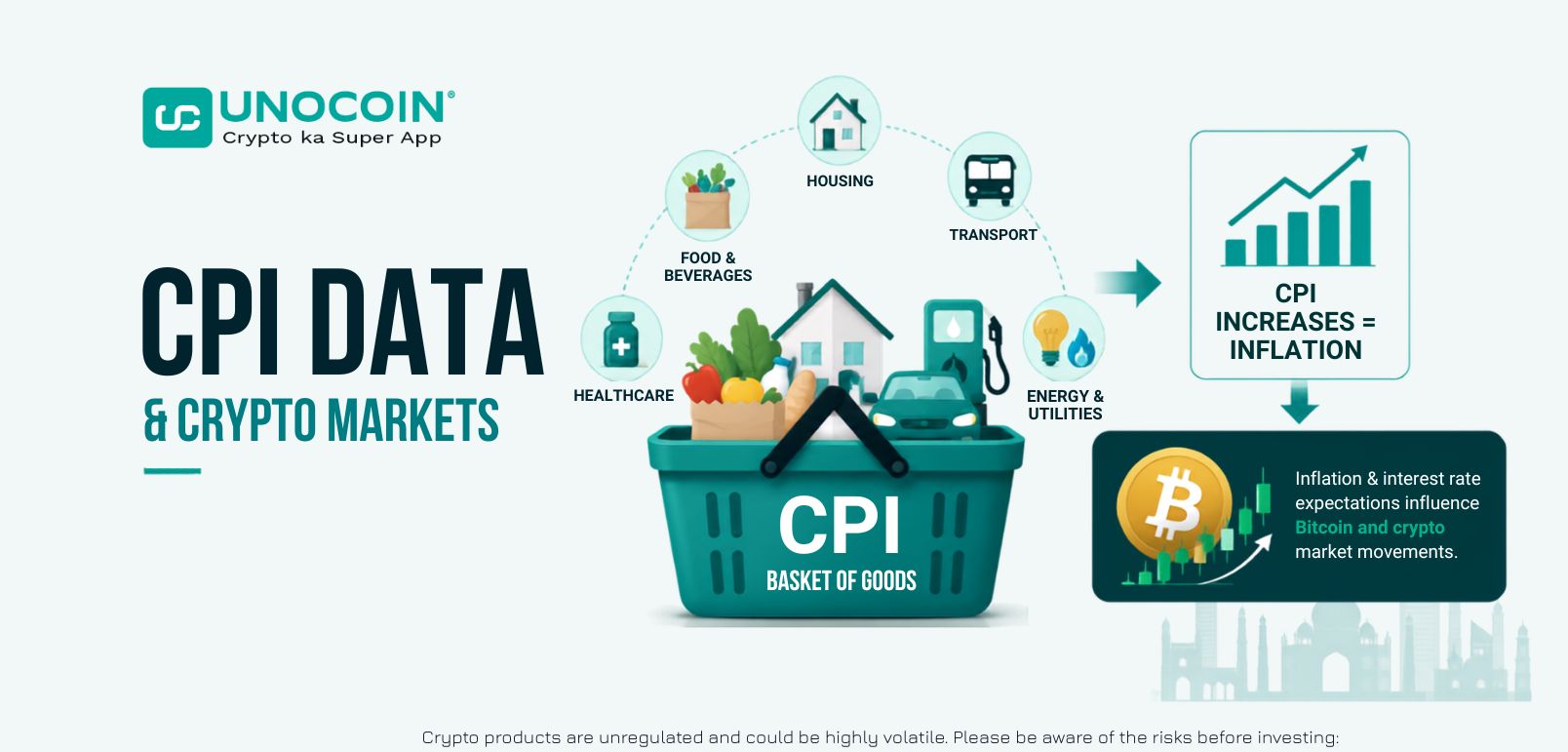
CPI data matters to Bitcoin and crypto markets because inflation drives expectations about interest rates, monetary policy, and liquidity — all of which influence investor appetite for risk assets. However, the key is not whether CPI is high or low — it is whether the number is higher or lower than what the market expected.
Key Takeaway
CPI does not directly predict whether Bitcoin will rise or fall. Crypto markets often react to how the actual inflation number compares with expectations — and what that could mean for future interest rates and liquidity. A number below forecast can be positive for risk assets even if the headline rate looks high in isolation.
CPI data is one of the most closely watched economic indicators by financial markets. But why does a monthly inflation report matter to Bitcoin and other cryptocurrencies?
The answer comes down to interest rates, liquidity, and investor expectations. When inflation comes in higher or lower than expected, markets can quickly reassess the outlook for monetary policy — and that can influence the US dollar, bond yields, equities, and other risk assets, including cryptocurrency.
For Indian crypto investors, both US CPI and India CPI are worth understanding. The US report can have a particularly strong influence on global risk sentiment, while India’s inflation data provides insight into the domestic economic environment.
The CPI basket how inflation is measured across goods and services
The Consumer Price Index (CPI) measures changes over time in the prices consumers pay for a basket of goods and services. It is one of the most widely used indicators of consumer-price inflation, tracked by governments, central banks, and financial markets worldwide.
This basket can include categories such as:
Food and beverages
Housing
Transportation
Healthcare
Apparel
Education
Energy
Recreation
CPI Example — How It Is Calculated
→A basket of everyday goods costs ₹10,000 in Year 1
→The same basket costs ₹10,400 in Year 2
→The increase is ₹400 — or 4%. That represents a 4% consumer-price inflation rate for the period.
What Is the Difference Between CPI and Inflation?
CPI and inflation are closely related — but they are not exactly the same thing, and it is useful to understand the distinction.
CPI
An index that measures changes in consumer prices over time. It is a number — a data point — produced by government statistical agencies each month.
Inflation
The broader economic phenomenon of rising prices across an economy. CPI is one of the most commonly followed measures used to understand and track inflation.
For investors, the important numbers within CPI releases are often the month-over-month (MoM) and year-over-year (YoY) changes:
MoM Month-over-Month: Compares prices this month with the previous month. Measures short-term price momentum.
YoY Year-over-Year: Compares prices with the same month a year earlier. The headline number most widely reported in the media.
What Is Core CPI? — Headline vs Core Explained
You will frequently hear financial markets talk about “core CPI” alongside the headline number. Understanding the difference is important for interpreting any CPI release.
Headline CPI
Includes the full basket of consumer prices — food, energy, and all other categories. This is the number most widely reported in the media.
🇺🇸 June 2026: +3.5% YoY
🇮🇳 June 2026: +4.38% YoY
Core CPI
Excludes food and energy — which can be particularly volatile. Core CPI helps assess underlying inflation trends without short-term commodity price swings.
🇺🇸 June 2026: +2.6% YoY
India core CPI tracked separately by analysts
Why Both Matter: A headline inflation number could fall because energy prices decline — while core inflation remains elevated. Investors therefore look at both figures before forming a view on the inflation outlook and monetary policy direction.
Why Does CPI Data Matter for Crypto?
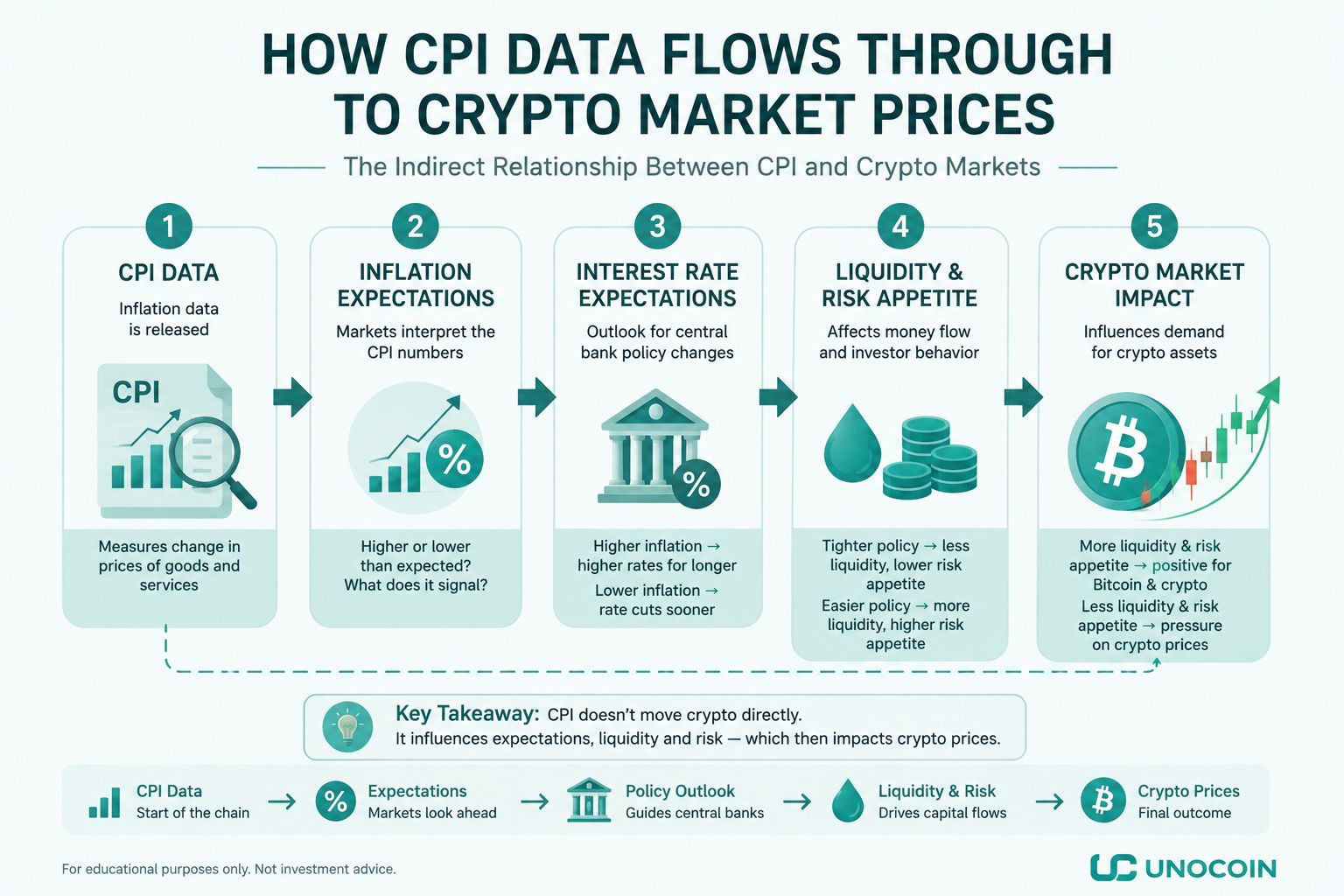
How CPI data flows through to crypto market prices
CPI does not directly determine the price of Bitcoin or Ethereum. Instead, its importance comes from the relationship between inflation and monetary policy. The transmission mechanism works like this:
CPI Data
→
Inflation
Expectations
→
Rate
Expectations
→
Liquidity &
Risk Appetite
→
Crypto
Markets
When inflation remains elevated, investors may expect central banks to maintain restrictive monetary policy for longer. Higher interest rates can make traditional assets such as bonds and cash more attractive relative to speculative or higher-risk assets — potentially reducing demand for Bitcoin and other cryptocurrencies.
On the other hand, if inflation falls more than expected, markets may begin to anticipate a more accommodative monetary-policy environment — which can improve risk sentiment and potentially benefit risk assets including crypto.
However, this relationship is not automatic. Crypto prices can move for many other reasons:
• Federal Reserve decisions
• Employment data
• Bond yields and treasury markets
• US dollar movements
• ETF inflows and outflows
• Institutional positioning
• Crypto-specific news and events
• Regulatory developments
• Market leverage and liquidations
• Geopolitical events
Bottom Line: CPI should be viewed as one part of the broader macroeconomic picture — not a standalone buy or sell signal for crypto. Understanding it in context is what matters.
Why Does US CPI Matter So Much to Bitcoin?
The US economy plays a central role in global financial markets, and the US Federal Reserve’s monetary policy has a significant influence on global liquidity and investor sentiment. As a result, US economic data — including CPI — is closely watched by investors around the world, including in India.
When US inflation data changes expectations about future Federal Reserve policy, the impact can extend beyond US stocks and bonds. Bitcoin and other cryptocurrencies can also react as investors reassess their exposure to risk assets globally.
Higher-Than-Expected CPI
→Inflation may appear more persistent
→Markets may expect rates to stay higher for longer
→Bond yields or USD may strengthen
→Risk appetite may weaken
→Crypto could come under pressure
Lower-Than-Expected CPI
→Inflation may appear to be cooling
→Markets may price in easier monetary policy
→Risk sentiment may improve broadly
→Bond yields may fall, USD may weaken
→Crypto could benefit
Important: These are possible market pathways — not guaranteed trading signals. The actual reaction depends on many other factors including how positions are already positioned, what central bank officials say afterwards, and broader market sentiment at the time.
Why the CPI Number Alone Is Not Enough
One of the biggest mistakes investors can make is looking at CPI in isolation. Markets care about surprises — not just the absolute number. The key question is always: did the data come in above, below, or in line with what the market expected?
To illustrate this, consider three scenarios where the market expects CPI to come in at 3.4%:
Scenario 1
CPI comes in at 3.2% — Below Expectations
The result is lower than the expected 3.4%. Investors could interpret this as evidence that inflation is cooling faster than anticipated. Depending on the broader economic environment, this could support expectations for easier monetary policy and potentially improve sentiment toward risk assets including crypto.
Scenario 2
CPI comes in at 3.4% — Matches Expectations
The market may have already priced in the number. As a result, the immediate reaction could be more limited — even if the headline figure looks elevated in isolation. “As expected” data often produces muted market moves.
Scenario 3
CPI comes in at 3.7% — Above Expectations
The result is significantly higher than expected. Investors could interpret this as evidence that inflation remains persistent — increasing expectations for tighter monetary policy or higher rates for longer. This could put pressure on risk assets including Bitcoin.
Real Example: US CPI June 2026 — Below Expectations
Market Expected
3.8%
Actual Result
3.5%
Core CPI (Actual)
2.6%
The June 2026 US CPI came in at 3.5% — below the Dow Jones consensus of 3.8%, and core CPI at 2.6% against approximately 2.9% expected. Energy prices fell sharply. The below-forecast reading boosted risk assets and raised market expectations for Federal Reserve rate cuts in the second half of 2026.
Key Lesson: This is why actual CPI vs expected CPI is often more important for short-term market reactions than whether the headline number looks high or low on its own.
US CPI vs India CPI — What Should Indian Investors Watch?
Indian crypto investors may encounter both US and Indian inflation data — but the two reports serve different purposes and carry different implications for crypto markets.
US CPI
Bureau of Labor Statistics (BLS)
3.5% YoY (June 2026)
Core: 2.6% YoY | MoM: -0.4%
Closely watched by global financial markets for its implications on US monetary policy and Federal Reserve decisions. Has the strongest influence on global risk sentiment and crypto markets.
India CPI
MoSPI (Ministry of Statistics)
4.38% YoY (June 2026, Provisional)
Food inflation: 5.32% | Base year: 2024=100
Provides insight into domestic inflation trends and the broader Indian economic environment. Relevant for RBI monetary policy decisions affecting the Indian Rupee and domestic financial markets.
When Is the Next CPI Data Release? — August 12, 2026
The next major CPI event for investors is August 12, 2026 — a significant date as both the US and India are scheduled to release inflation data on the same day.
US CPI — July 2026
Date: August 12, 2026
Time: 8:30 AM ET / 6:00 PM IST
Publisher: US Bureau of Labor Statistics
India CPI — July 2026
Date: August 12, 2026
Time: 4:00 PM IST
Publisher: MoSPI
After the numbers are released on August 12, investors should look at:
•Headline CPI and core CPI figures
•Month-over-month and year-over-year changes
•How the actual figures compare with market expectations
•How Treasury yields and the US dollar react immediately
•How Bitcoin and the broader crypto market respond
How Can Crypto Investors Approach CPI Volatility?
CPI releases can create short-term volatility in crypto markets. Rather than treating an economic release as a guaranteed buy or sell signal, investors can focus on managing risk and understanding the information behind the market move. Here are four practical approaches:
1
Avoid reacting to the first price move
Crypto markets operate around the clock, and major economic announcements can trigger sharp price movements within seconds. The first move after a CPI release does not necessarily determine the longer-term direction. Investors with a longer time horizon may prefer to wait for the market to digest the data fully before making decisions.
2
Compare actual data with expectations
Do not simply ask “Was CPI high?” — ask “Was CPI higher or lower than what the market expected?” A CPI reading that looks high in isolation could still trigger a positive reaction if it is lower than anticipated. Similarly, a seemingly low CPI number could disappoint markets if expectations were even lower.
3
Look beyond CPI — the broader picture
CPI is only one piece of the macroeconomic picture. Additionally consider: Federal Reserve policy and communications, US Treasury yields, employment data, GDP growth, the US dollar, global liquidity conditions, and any major crypto market developments. Considering multiple indicators provides a more complete view.
4
Consider a systematic investment approach — Unocoin SBP
For long-term investors, trying to predict every CPI-driven price movement can be difficult and often counterproductive. A Systematic Buying Plan (SBP) on Unocoin spreads purchases over time rather than concentrating them around individual economic events — reducing the need to pick the “perfect” entry point each month.
Does High CPI Mean Bitcoin Will Fall?
Not necessarily. High CPI can put pressure on Bitcoin — but prices can move in the opposite direction depending on positioning, liquidity, and other factors.
High CPI ≠ guaranteed Bitcoin decline
Does Low CPI Mean Bitcoin Will Rise?
Again, not necessarily. Low CPI can improve risk sentiment — but Bitcoin can still decline if other factors dominate market sentiment at the time.
Low CPI ≠ guaranteed Bitcoin rally
CPI and Crypto — What Should Investors Watch? Full Checklist
When the next CPI report arrives on August 12, 2026, use this checklist to approach the data systematically rather than reacting emotionally to the first price move.
Before the Release
?What is the market expecting?
?What was the previous month’s CPI reading?
?What are economists forecasting?
?What are bond yields doing ahead of the release?
?What is Bitcoin already pricing in?
After the Release
✔What was the actual headline CPI?
✔What was core CPI (excl. food and energy)?
✔Was the number above or below expectations?
✔How did Treasury yields react?
✔How did Bitcoin and crypto markets respond?
Why This Helps: This approach helps investors understand why the market is moving rather than simply reacting to a green or red candle — building better decision-making habits over time.
Frequently Asked Questions About CPI and Crypto
QWhat is CPI data?
CPI data measures changes in the prices consumers pay for a basket of goods and services over time. It is widely used as an indicator of consumer-price inflation and published monthly by government statistical agencies — the BLS in the US and MoSPI in India.
QWhy does CPI affect Bitcoin?
CPI can influence expectations about inflation, interest rates, and monetary policy. Those expectations affect liquidity and investor appetite for risk assets such as Bitcoin. Higher-than-expected CPI may reduce risk appetite; lower-than-expected CPI may improve it.
QIs high CPI bad for crypto?
A higher-than-expected CPI reading can create pressure on crypto if investors expect interest rates to remain elevated for longer. However, the market reaction is not guaranteed — positioning, liquidity, and other factors all play a role.
QIs low CPI good for Bitcoin?
A lower-than-expected CPI reading can support risk sentiment if investors interpret it as a sign of easing inflation and potentially more accommodative monetary policy. However, Bitcoin can still move lower depending on other market factors — low CPI does not guarantee a rally.
QWhat is core CPI?
Core CPI excludes food and energy prices from the CPI calculation. It is commonly followed by economists and central banks because food and energy prices can be relatively volatile — core CPI provides a cleaner signal of underlying inflation trends.
QWhen is the next US CPI report?
The US Bureau of Labor Statistics has scheduled the July 2026 CPI report for August 12, 2026, at 8:30 AM Eastern Time — which is 6:00 PM IST.
QWhen is India’s next CPI report?
MoSPI’s 2026–27 advance release calendar lists August 12, 2026 for the release of India’s July 2026 CPI data — the same day as the US report, at 4:00 PM IST.
QDoes CPI predict Bitcoin’s price?
No. CPI is an economic indicator and should not be treated as a Bitcoin price predictor. Crypto prices are influenced by many macroeconomic and market-specific factors. CPI is one useful input — not a trading signal on its own.
QShould I buy Bitcoin before CPI?
There is no universally optimal time to buy Bitcoin before a CPI release. Rather than timing one economic event, consider your investment horizon, risk tolerance, and overall strategy. A Systematic Buying Plan (SBP) on Unocoin can help you invest consistently regardless of the economic calendar.
Final Takeaway
CPI data matters to crypto investors because inflation can influence expectations around interest rates, monetary policy, and liquidity. The most important lesson is that the CPI number itself is not the whole story — markets often respond to the difference between what was expected and what the data actually showed.
For crypto investors in India, keeping an eye on both US and Indian inflation data can provide useful context for understanding broader market conditions. But CPI should not be used as a standalone buy or sell signal. Instead, treat it as one piece of the larger market picture — alongside monetary policy, interest rates, liquidity, market sentiment, and crypto-specific developments.
Disclaimer
This article is for informational and educational purposes only and does not constitute financial, investment, or trading advice. CPI data cited is sourced from official publications by the US Bureau of Labor Statistics and India’s Ministry of Statistics and Programme Implementation. Crypto investments are subject to market risk. Always conduct your own research and consult a qualified financial professional before making investment decisions. Crypto products are unregulated as of this date in India and could be highly volatile. Please DYOR (Do Your Own Research).
Invest in crypto consistently — regardless of the economic calendar.
Set up a Bitcoin SBP on Unocoin from ₹100/week and let rupee-cost averaging do the work.